Showing posts with label values. Show all posts

7/22/12

Batman, God - and The Joker: the Shooting in Aurora

(I don't know the author of this piece but thought it was worth posting/sharing.)

  By Paul Asay


It reads like the scene from a Christopher Nolan Batman movie.

A man, heavily armed and wearing a bulletproof vest, opens fire on a theater full of innocents, killing 12 people and wounding scores of others. Officials find signs his apartment may be booby trapped — trip wires tied to what appear to be homemade bombs. When police remove the killer’s gas mask, they discover the suspect — 24-year-old James Holmes — has dyed his hair red.

The Joker, he calls himself.


If only it had been a scene. If only the people in that Aurora, Colo., theater could’ve watched the horror unfold on screen, it would’ve made some sort of sense. It would’ve driven the plot forward, pushed Nolan’s brooding Dark Knight into action. And after Nolan called “cut,” actors and extras would’ve gotten up, brushed themselves off and walked away.


But there in Aurora, there was no Batman to stop the killer, no director to cut the scene. There was no plan to it, no plot — at least not that we can see. It’s just a tragedy — another senseless horror in a world that’s known far too many.


Of all the words that can be used to describe the Aurora shooting, “senseless” may be the worst word of all — particularly for those of us who call ourselves Christian. We claim to worship a good, just and all-powerful God — a God who loves us with a passion as broad as the universe itself. We are His children, we say. And God wouldn’t let any harm come to His children … would He?


And the question hangs in the air, waiting, pleading for an answer.


It’s sadly appropriate Holmes took on The Joker’s persona. He, among all of Batman’s archvillains, offers the worst possible answer to that hanging question: God? he chirps, brushing a hand through his caterpillar-green hair. How quaint. How precious. There is no God. There is no meaning. There is no reason in this cold, dark place. The only truth is that there is no truth.

“I’m not a monster,” he tells Batman in The Dark Knight. “I’m just ahead of the curve.”


The clash between Batman and the Joker is a struggle between meaning and meaninglessness. And that struggle goes to the core of our being.


We don’t know what sort of faith Batman has — what he believes in, if anything. But it’s obvious he believes in meaning — an overarching sense of purpose that transcends our biology and upbringing. For Batman, right and wrong aren’t just man-made constructs, but eternal ideals. He believes our lives have purpose: I believe that’s why he protects the people of Gotham with such verve and holds himself to such strict standards.


But the Joker, he doesn’t believe in any of that stuff. Right and wrong, life and death, it’s all part of the same cosmic joke. Meaning? Pish.


That’s why The Joker never goes away, I think — not for long, at any rate. His philosophy is too frightening to vanish completely. In his grinning visage, Batman faces his own secret doubt — doubt that many Christians like me sometimes face during the darkest moments of our lives. We wonder, in the wake of our Auroras, whether we’re behind the curve. Senseless tragedy hits us in the gut. Any explanation we might give, any words of hope we might try to offer, seem so inadequate: A joke that only the Joker could laugh at.


And yet there is hope. And we see a shadow of it in Batman.


The superhero’s fictional Gotham is a dark, brutal and often senseless place — a comic-book mirror of our own flawed and failing world. Batman knows it well. When he was just a boy, his parents were murdered in front of him.

I doubt Batman believes God was there in that alley that night when his parents were killed. And yet, a seed of a future hero was sewn in that awful moment. God didn’t pull the trigger. He didn’t “cause” that tragedy. But I believe God could’ve, in this fictional universe, worked through it. In the midst of Bruce Wayne’s darkest night, a Dark Knight was born.

I can’t say where God was yesterday in that Aurora theater. I’m no theologian, but personally, I doubt whether such evil could be part of God’s original, ideal blueprint. But I do believe this: That in the midst of such senseless tragedy, God is with us and, if we let Him, He can work through us. In the crux of our pain and confusion, He’s there—infusing this meaningless tragedy with meaning, offering hope in the midst of this helplessness.

**

Paul Asay is the author of God on the Streets of Gotham: What the Big Screen Batman Can Teach us About God and Ourselves. He works as a movie reviewer with the Christian outlet Pluggedin.com.


-------------------------------------------------------------

2/25/11

Do You Spit Stones????

Sometimes it seems that “being nice” to others isn’t very important to people any more.
And we’ve heard quite a bit about the need for civility during the last year or two or so.

But I guess this isn’t anything new. Apparently, even George Washington stressed civility.

Because we’ve just celebrated Presidents’ Day this week and because the 22nd was George Washington’s birthday, I thought this might be a good time to share some of our first president’s rules of civility. These are some of my favorites from his list of over 100:


When in company, put not your hands to any part of the body not usually discovered.

Sleep not when others speak; sit not when others stand; speak not when you should hold your peace; walk not on when others stop.

In the presence of others, sing not to yourself with a humming voice, or drum with your fingers or feet.

Play not the peacock, looking every where about you, to see if you be well decked, if your shoes fit well, if your stockings sit neatly and clothes handsomely.


Reprehend not the imperfections of others, for that belongs to parents, masters, and superiors.


Gaze not on the marks or blemishes of others and ask not how they came. What you may speak in secret to your friend, deliver not before others.


Undertake not what you cannot perform but be careful to keep your promise.


Speak not evil of the absent, for it is unjust.


Being set at meat scratch not, neither spit, cough, or blow your nose except there's a necessity for it.


Take no salt or cut bread with your knife greasy.


Drink not nor talk with your mouth full; neither gaze about you while you are a drinking.

 Put not your meat to your mouth with your knife in your hand; neither spit forth the stones of any fruit pie upon a dish nor cast anything under the table.


Washington’s list goes on. How do your ideas about civility compare to those of George Washington?


2/14/11

Well, Excu-u-u-u-s-e Me!!!!


How do you figure out when to start teaching children manners, etiquette and good behavior? I guess it’s right from the beginning, huh?


Of course, children certainly must get mixed signals, because sometimes we adults aren’t very good examples, are we?


My daughter Mandy and son-in-law, Adam, have done what I think is an excellent job with Harrison, who is not quite three years old.

They started with the usuals – “thank you,” “you’re welcome” and “please.”


Among the many others they taught him was the one they themselves learned at Chick-fil-A. That’s where Mandy and Adam met as fellow employees. (Both, by the way, continue with Chick-fil-A: he as operator of the Murrells Inlet store and she as a grand opening consultant.)

Anyway, if you’ve ever been a customer at Chick-fil-A, you probably know that if you say “Thank you,” the employee responds with “My pleasure.”

So, Harrison learned to say “My pleasure” as well as “You’re welcome.”

And they taught him other appropriate phrases, such as “I’m sorry” and “Excuse me.”

Like all children, Harrison occasionally had to be prompted. After all, it takes time to learn and to let new things become habit.


One day, Harrison, ahem, “passed gas” rather loudly. His parents asked, “What do you say, Harrison?”

He promptly replied, “My pleasure!”

I’m sure the relief he felt did indeed feel pleasurable.

And isn’t that a feeling that we all know?!?!


 ~~       ~~        ~~        ~~

1/25/11

Somebody's Got It Right!!!

Well, thank goodness, somebody’s got it right!


In a recent news conference involving Wal-Mart executives and First Lady Michelle Obama, Wal-Mart announced that it would start selling healthier food products.

Not only is the giant retailer planning to have healthier choices available for shoppers, it also plans to make those healthy foods more affordable.

I say, “Hurrah.”

But my cheers aren’t specifically for Wal-Mart or for Michelle Obama or even for healthy foods. My cheers are for the concept.

What concept? It’s the idea that private industries and businesses can take positive steps to benefits consumers without being forced to do so by the government.

Although it’s a concept that we seem to have lost in recent history, I believe it’s the real “American way.”

I’ve always believed that government is not supposed to be the answer to every question, the solution to every problem. Government involvement, also known as government interference, should be a last resort, if used at all. Government assistance and government regulations shouldn’t be the first response to our needs and problems.

As someone once said, “A government big enough to give you everything you want is big enough to take away everything you have.”

It seems that if business and industry didn’t have to spend so much time and jump through so many hoops to meet government regulations, there would be much more creativity and innovation in meeting needs and challenges.

It’s a concept worth bringing back, don’t you think?

                    *                                    *                                   *                                  *

1/17/11

It's About Balance and Drawing Lines

WARNING: This is a serious message, not my usual light-hearted scribbling.

Freedom of speech is awfully important to us, isn’t it? In fact, we hold dear all of our basic freedoms, liberties and rights.

Having the right to do something, though, doesn’t mean that “something” should be done.


For example, in our country, individuals have the right to burn “Old Glory,” our flag, the piece of cloth that is a symbol of our wonderful country. That doesn’t mean people ought to burn the flag, however.


Our citizens have the right to burn the Bible – or the Koran or any other book. Again, recognizing the right to carry out these activities doesn’t mean agreeing that it should be done or that we shouldn’t be repulsed when such takes place.


People have the right to demonstrate and picket, whether they are promoting something or protesting against it.

Yes, we have wonderful freedoms in this country as long as we don’t do harm to others and infringe on their rights.

But, just where do we draw the lines? It’s the figurative locations of those lines that concern me. What has brought up the concern this time?

It’s the Westboro Church members who protested with signs near the funeral of 9-year-old Christina Taylor Green. Those church members have the right to speak their minds, both with words and with signs.


But what about the rights of family members during such unimaginable times of grief and sorrow? Not just Christina’s family but also the families of our military heroes who have given their lives? Where are their rights to privacy?


Do we take away the free speech rights of picketers? Or do we allow the demonstrations but instead restrict the time and place?

For example, should we allow them to march with signs but not within an hour prior to a funeral service until an hour after the service? Do we restrict them to an area outside close proximity to the funeral service and burial site?

This is another time when I have questions but no perfect answers.

What do YOU think?


~                    ~                  ~                   ~

1/8/11

It's All About Delivery - but Not About Babies

This is about delivery but it’s not about babies.

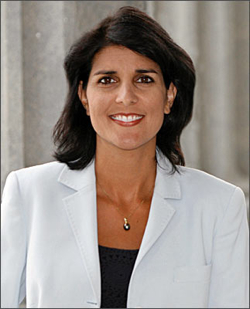
It’s about deliveries, assumptions, politics, intellectuals, prejudices, Nikki Haley, blondes and more. Strange combinations, don’t you think?

That Nikki Haley becomes our new governor this week is what prompted my weird collection of thoughts.


Haley, of course, is our state’s first female governor. Of Indian heritage, she is our first minority governor. She becomes the nation’s youngest governor. Believe it or not, there are still – in 2011 - a few individuals who think a woman shouldn’t be governor, or that a minority shouldn’t be or that a relatively young person shouldn’t be.


It was in early January 40 years ago that I served my very first day in the state legislature, becoming the nation’s youngest lawmaker. There were many who thought I was too young and/or that a female had no place in the law-making process.

And there were then - and still are - folks who believe that a blonde can’t have brains!

Perhaps Nikki Haley overcame some of the prejudices by the way she delivered her message. Delivery is extremely important in the election process.

One of the smartest and brightest people I ever served with in government was the late Heyward Belser. He was so much the intellectual that most of us couldn’t keep up with him or even understand him.

At one point, Belser ran for lieutenant governor in the Democrat’s primary. Notwithstanding any of the attributes of other candidates, I’m convinced that he wasn’t more successful in that race because he was too brilliant and the brilliance showed in his speeches. His delivery was lacking when it came to relating to most people.

There are some who believe Sarah Palin isn’t very bright because of her delivery style, which includes smiling and winking. My point is not whether she is or is not bright but how we judge folks.

We should not judge or base our decisions on smiles, hair color, ethnicity, age or other such factors.

Forty years ago, there were many who thought I didn’t know much because of my age. Most definitely, there were some things I didn’t know. Now I’m 61, and there are still things I don’t know.

Lack of knowledge on some subjects is true for every human being, regardless of age, ethnicity, facial expressions, religion or education.

Or hair color.

*                        *                       *                          *

7/27/10

Lindsay, Michael, Brian, Matt and More

This is what my oldest daughter, Tiffany (pictured on the left), posted on Facebook several days ago: Can you believe the news coverage being given to a spoiled 20-something this week? Lindsay WHO? Here are a few 20-somethings worth knowing about: Justin Allen, 23; Brett Linley, 29; Matt Weikert, 29; Justus Bartett, 27; Dave Santos, 21; Chase Stanley, 21; Jesse Reed, 26; Matt King, 23; Chris Goeke, 23; and, Sheldon Tate, 27. These 20-somethings gave their lives for you this week.
Tiffany hit the proverbial nail on the head, didn’t she? Where ARE our values? Far more people know the name of Lindsay Lohan than the names of those young members of the military who made the ultimate sacrifice.

Has the loss of life in the military become something that is just a number, just a statistic in the news? And are our values as a society such that we idolize celebrities like Lindsay Lohan?

Similarly, does the name of Brian Bradshaw ring a bell for you? No? He was the 24-year-old soldier who was killed in Afghanistan on the same day Michael Jackson died – June 25, 2009. A Pacific Lutheran University graduate, Bradshaw was, according to his aunt, "…a search-and-rescue volunteer, an altar boy, a camp counselor … [who] carried the hopes and dreams of his parents willingly on his shoulders. What more than that did Michael Jackson do or represent that earned him memorial 'shrines,' while this soldier's death goes unheralded?"

I am not questioning Michael Jackson’s talent or that of Lindsay Lohan. What I question is the attention given to them and the lack of attention to our young people who are true heroes.

6/20/10

Father's Day - Without My Dad

Father's Day - Without My Dad


NOTE: Usually I post only light-hearted stuff, but today is Father's Day, so I'm doing something a little different. It has been 9 years since my dad died. The following is what I wrote that appeared on the op/ed page of Charleston's Post and Courier on my first Father's Day without Dad and has appeared on this blog previously:


This is my first Father’s Day ever without a father.

He was “Dad” for 52 years and now he’s gone, but memories will cause him to live on forever, and what wonderful memories they are.

Today, on a bittersweet day, I celebrate his life – the person he was, the father he was, the qualities he shared and the principles for which he stood.

Dad was adopted as an infant and then lost his adoptive father before he started school. At the age of 6, he was the “man of the house,” with the chore of plowing the field each day. He used to tell us stories about starting his day staring at the back end of a mule.

At the 10th-grade level, Dad quit school and went to work in Charleston as an apprentice pipe fitter. In 1942, he joined the Navy, saw action in the New Guinea, Borneo, Gilbert Islands, Marshall Islands and Saipan campaigns and in the liberation of the Philippines. He survived the sinking of the USS Hugh L. Scott and a gunshot wound to the neck before receiving an honorable discharge on Jan. 6, 1947. I remember being in the back seat of our car when he was driving, looking at the scar left by a bullet on the back of his neck.

Although he earned his high school diploma while in the Navy, he returned to Batesburg-Leesville High School to “brush up: for college. It was there that he had a math teacher named Elsie Elizabeth Porth. One day, instead of turning in his assignment, he wrote a note to the teacher, asking her for a date. On June 15, 1947, she became his wife.

In the early 1950s, he became a candidate for the S.C. House of Representatives; he had never been in politics, had no relatives or friends in politics and had never been inside the Statehouse. He won, and went on to win more.

The first election he ever lost was after he was offered $50,000 to change his vote on an issue or otherwise have the $50,000 spent against him. Dad didn’t budge; he lost that election by only nine votes – and he didn’t request a recount.

Frequently referred to as a maverick, he was unconventional in his approach to numerous issues. When other committee members studying the navigability of the river system from Columbia to the Charleston harbor decided to go by boat between the two cities, Dad stayed behind – literally: He made the 180-mile trip on skis and repeated the trip later. The same journey was made in the late 1990s by his two sons (my brothers), Rod and Shawn; Dad was inside the boat for this trip.

During his 24 years in the Legislature, he became identified with several issues, most recently with the lottery. He was the first public official in modern history to promote a lottery referendum. Starting the early 1980s, he introduced lottery legislation every year until he retired in 1992. Dad traveled the state, laying the groundwork for lottery support and answering critics. [Interestingly, he was an adamant non-gambler himself.] He also held the best legislative attendance record – never missing a day – and best roll-call vote record for 23 years.

As a House member, he held a long-time filibuster record when he opposed price-fixing legislation; a notable filibuster in the Senate was his 27-hour diatribe on the accommodations tax.

Over the years he worked as a farmer, clerk, laborer, salesman, teacher, businessman and, for several years, was a professional boxer known as the “Blond Tiger.”  (He's the one in the middle in the picture.)

To me, he was Dad. What a family man he was. He and Mom had been married almost 54 years when he died in March. The five children never heard Dad say anything negative about Mom; he treated her like a queen. He had a glass of juice waiting for her at her bedside every morning for many years. He gave up the practice of law, which he loved, when her promotion necessitated an out-of-state move [to Tennessee from SC], and he became a real-life “Mr. Mom.”

At night, he read to all five children when we were young – and since the age span runs 52 to 32, that adds up to a lot of reading. And he continued to set an example as he spent hours and hours just reading to learn.

He taught himself to play the piano, banjo, guitar, accordion, ukulele and mandolin and encouraged us in musical fields.

He taught me how to use a sling-shot but forgot to impress upon me the direction in which to use it, so I successfully shot a rock straight back into my face. He made us swings with bushel baskets from a farm.

Dad didn’t place many restrictions and boundaries on us: There were a few basics that he expected. We knew he expected those things, not because he said so, but because that’s what he demanded of himself.

He and Mom also taught us the importance of laughter. We laughed about things we could not change – like the time he built us a three-room cement block house to live in. This was his first effort as a “builder.” He installed what we called roll-out or Florida windows – but he put them in backward. Every time it rained, we had to run outside to roll the windows shut. They were cemented in place, so there was nothing left to do but laugh.

First diagnosed with cancer late in 1974, he was almost like a cat with nine lives. In addition to surviving the sinking of his ship, the gunshot wound and his boxing career, he later was diagnosed with three kinds of cancer, suffered a light stroke, suffered with arthritis and had three pacemakers. When he received his first pacemaker, the doctor advised him to go home and not use his left arm for a while. Instead, Dad drove to the golf course and played a round of one-handed golf.

Up until a few months ago, he played golf often, learned to use a computer and kept reading. The garage is full of stuff that he “almost invented “ – a/k/a contraptions. And then, in March, he slipped away, finally at peace and out of pain. But before he left us, he wrote “good-bye” notes to each of the five children and a final note to Mom, his high school math teacher and wife.

After he died, someone described him as a “character with character.” Indeed, he was a character; and, indeed, he had character.

Just before he died, he asked for watermelon and a small bottled Coke. After a frantic search, I returned to the hospital with those items. He slowly ate three pieces of watermelon and took three sips of that small bottled Coke. These were the last things he had.

Such simple requests – but so very typical of him. He never asked for much for himself in life; he was a giver.

Oh, Dad, I miss you.

Happy Father’s Day.

Love,

Sherry


10/5/09

It's About Sex

I don’t write about sex very often. Maybe it’s because I don’t know very much!

But I just read that October is National Family Sexuality Month, an effort to promote open communication within families about sexuality.

Well, this reminded me a particular day many years ago. I’ve written about it before, so if you’ve already read it, just bear with me.

It was a Saturday afternoon and I was at home with the three children, all of whom were quite young at the time.

According to the newspaper’s TV schedule, a show was coming on late that afternoon about teaching children how to say “no” to strangers.

Excellent, I thought. As a mother of youngsters, I wanted them to stay away from strangers and not to be tempted ever by candy or any other enticement. Without being pushy, I had us all in the room with the television when the program began. And so, we sat down and casually tuned in to watch the show.

After a few minutes of discussion about saying “no” to strangers, the conversation changed somewhat. It went from saying “no” to strangers to just saying “no” in general. And then, finally, the program’s focus turned to relationships between teenagers and beyond. The talk was about saying “no” to “doing it.” Should a person wait for love? True love? Commitment? Marriage? What? When was the right time?

As one might imagine, the children were engrossed in the discussion. Then all of a sudden, Tiffany blurted out, “I’m confused!”

“Why?” I asked.

“Because,” she replied, “they’re talking about when to do it and I don’t even know what it is!”

Keep watching, honey, just keep watching.

And there you have it - our celebration of National Family Sexuality Month!

9/21/09

I Remember Hugo: Twenty Years Later

Twenty years ago tonight, Hurricane Hugo came ashore in coastal South Carolina and then moved inland.


At the time I was a member of the SC state senate. The district I represented bore the brunt of Hugo. It was a long but relatively narrow district along the coast, including McClellanville, Awendaw, Isle of Palms, Sullivans Island, Mt. Pleasant, Folly Beach, James Island, Johns Island, Seabrook Island, Kiawah Island and surrounding areas.

As much as I like to write, I just can’t think of the words to adequately describe how ravaged the area was, how extensive the damage was. It was just beyond comprehension.  In South Carolina, 13 lives were lost.

Where there used to be a home, there was a single chimney or perhaps just the remnants of a bathroom. Another house was literally split in two. There were mattresses in what used to be front yards. Thousands and thousands of trees were upended. Trees made holes in rooftops – where rooftops remained. The only bridge leading to Sullivan’s Island and on to the Isle of Palms was damaged and could not be used. People could not return to their homes, or even visit to find out if their homes remained. Water flooded many homes that actually remained standing.


I could go on and on and on about the devastation, because it certainly went on and on; it was widespread and far-reaching. Instead, I want to share three particular remembrances.


Within days, I went up in a Black Hawk helicopter with Billy Graham, Gov. Carroll Campbell and Rep. Harry Hallman. We looked at the destruction from the air. What a view that was! Billy Graham, who certainly has traveled throughout the world, said it was the most extensive destruction he had ever viewed.


A second vivid memory is the spirit of community that came out of this terrible event. People helped each other. People worked together. There was a charitable, giving, caring, helping spirit among all. For weeks many of us didn’t have electricity and water. We were all dirty together. Neighbors shared food, chain saws, the much-treasured ice and water. It was a heart-warming experience.  At our home, since we had a large outdoor grill, families gathered nightly for food.  People brought food from freezers that were no longer working and we all cooked and ate together.  And churches that could be used were used.  People returned to worship services in tremendous numbers.

The third memory is of a sight in the small fishing village of McClellanville. In the midst of piles and piles of rubble that used to be homes, someone had planted a large American flag. It represented the epitome of the American spirit. It said, “We are going to be okay.”

It took many, many months, even years, but, yes, we eventually were okay. People joined hands and made it through those times which, at first, seemed overwhelming and almost insurmountable.


Flickr photos by scmikeburton, band4atl, japee and michelinecallicot.

9/18/09

O, Civility, Where Art Thou?


What has happened to us as a society? Why are we, generally speaking, no longer civil to each other?


Look at the last 10 days or so. Kanye West’s tirade in the midst of Taylor Swift’s acceptance speech, Joe Wilson’s outburst during the president’s speech, Serena Williams’ obvious crude language directed toward the referee, Federer’s display the following day. 

Since all or most have apologized, it seems they knew they were out of line - at least after the fact.

For decades, presidents have talked about the need for civility. So have others – poets, authors, entertainers and more. Look at the following quotes:

As citizens we have to be more thoughtful and more educated and more informed. I turn on the TV and I see these grown people screaming at each other, and I think, well, if we don't get our civility back, we're in trouble. Emmylou Harris

There can be no high civility without a deep morality. Ralph Waldo Emerson

Civility costs nothing, and buys everything. Mary Wortley Montagu
All of civility depends on being able to contain the rage of individuals. Joshua Lederberg

When once the forms of civility are violated, there remains little hope of return to kindness or decency. Samuel Johnson


Just a few years ago, the SC Supreme Court adopted an “oath of civility” that attorneys are required to take to practice law in South Carolina. How in the world did we get to such a point that the court has to require such an oath?

Is it television? Movies? Is it lifestyle? Is it the lyrics in today’s music? Is it the mudslinging in politics? Is it the 24-hour coverage of everything under the sun? Is it a feel-good society or a lack of personal responsibility in society?

Is it money or greed?  Is it the need to win - at sports, politics or whatever?

I don’t have the answers but certainly do welcome your comments, thoughts and ideas.


8/18/09

Is Social Networking IMPERSONAL?


Is social networking impersonal?
Critics often complain that we are becoming a society of recluses, hidden behind computer screens, fearful of human interaction.

I absolutely and strongly disagree.

There’s no question that I spend a lot of time at the computer. In fact, I’m beginning to believe the laptop is an extension of me. Borrowing Karl Malden’s words, I’d say I "don’t leave home without it.”

I’m addicted to the computer; I have withdrawal symptoms if I have to do without it.
I use Twitter, Facebook and Blogspot, currently updating three public blogs and one private blog.

Do I fear human interaction? Oh, no. I love human interaction.

Social networks have allowed me to find old friends, people with whom I had lost contact. Social networks have allowed me to make new friends, some of whom I’ve never met face to face but who seem just as close and familiar as some others. Social networks have allowed me to keep up with what friends and family members are doing, even those things I'd rather not know.

Sitting at a computer doesn't inhibit conversation any more than reading book, working a crossword or perhaps even being engrossed in a TV program.

Many of us are more personal with our writing than we are with our speaking. Perhaps we get to know more about others and share more of ourselves this way.


When Mom sends an e-mail to all of the family members, we know exactly what she's thinking! She writes the same way she talks.

When “The Dawg” got sick and was hospitalized several times, I kept a blog about him to let family and friends keep up with his condition. It was so much easier than calling 20 to 50 people, especially since I was usually in the hospital room and he was often sleeping or watching TV. We posted pictures of hospital staffers and got to know them much better by doing so.


His last days were described on the blog and even his death.
I shared my heartache at losing my husband and soul mate but also shared his desire not to linger and suffer. These were bittersweet postings, of course.


At the same time, I heard from hundreds of people, first wishing him well, offering prayers and then expressing condolences. Yes, there were some “traditional” cards that came through the mail, but there were many more expressions of sympathy on his blog and on mine, on Facebook, on Twitter and through e-mail.

These were no less personal than hand-written cards. What’s more, they were instantaneous and helped with the grieving process, just as writing helped me with the grieving process. I wouldn’t trade those communications for anything. I felt caring and concern from the senders.

When my dad died of cancer just over 8 years ago, I didn’t have a blog; there was no Twitter or Facebook, but there was e-mail. I notified loads of people about his death by e-mail and received many sympathy messages by e-mail.


One good thing about the e-mail communications was that I was able to print copies of the messages for each family member. That’s something I couldn’t do with traditional cards and phone calls.

In some ways, social networking has advantages and may even be preferable.


Etiquette experts may frown on the use of a computer for anything connected with emotions. I don’t, but, of course, as those who know me will attest, I’m certainly no etiquette expert!
Social networks are convenient. No trips to the post office. No worrying about calling someone who may be sleeping or busy. Messages are sent at the sender’s convenience and read at the recipient’s convenience.


One person sent an e-mail expressing sympathy when Carroll died but also apologized for using e-mail, saying she couldn’t find a current mailing address. I assured her this was fine. Her message was the same, regardless of the format. I felt no less comforted by words that were typed rather than hand-written.


What do you think? Do you offer sympathy, greetings, congratulations, best wishes and so forth by way of computer?
Is this a way to show joy at someone's good news and celebration? Is this kind of communication less personal?
Is it okay? Is it acceptable? Or, are we really humans fearful of “personal” communications and interaction?

7/7/09

Michael Jackson and Us: Why Am I Even Writing About This?

Add me to the list of those not quite understanding all of the hoopla surrounding the death of and memorial service for Michael Jackson.

He died on June 25th, the same day my husband, The Dawg, died. It’s been 12 days.

Yes, Michael Jackson died at what our society considers an early age: 50.

Yes, Jackson’s death was a surprise; it was unexpected. We knew Farrah Fawcett was seriously ill and nearing death, so when she died on the same day, it was not a shock.

Perhaps some people thought Michael Jackson was healthy. As the clips of Michael Jackson from the last year or so fill the television screens, I see someone who walked as though he were drugged on occasion, or on several occasions. He didn’t look healthy to me.

Yes, there are questions and suspicions about Jackson’s death. How did he get the drugs found in his system? How did he get those quantities?

Michael Jackson was a talented musician and a terrific performer, but other performers have died in the last few weeks: Karl Malden, Gale Storm, Billy Mays, Fred Travalena, Ed McMahon, David Carradine, for example. Were they as sensational as Jackson?

Probably not.

Nor were they as controversial. Questions and allegations were a big part of the last several years of Jackson’s life. Some even described him as “freakish.”

Still, the coverage of the aftermath of Jackson’s death has gone beyond the pale. (No pun intended.) Today the three major networks are changing regular programming to cover the memorial service.

This kind of treatment is usually reserved for presidents and royalty. The last time I remember so much hoopla was in 1997 when Princess Diana was killed in a car crash. But, of course, Jackson was royalty of a sort; he was the “King of Pop.”

Probably more influential to music, though, was James Brown, the “King of Soul.” There was no such extensive coverage for him.

Yesterday, seven American servicemen were killed in Afghanistan. Those are the heroes and they are the ones who deserve the coverage.

Where are our values?


Jackson photo from Wikipedia.
 
This site was recently updated by oxymoron13@aol.com